How to Cook Pasta in the Instant Pot

Published Dec 10, 2019•Updated Jan 28, 2026
This post may contain affiliate links. Please read our disclosure policy.
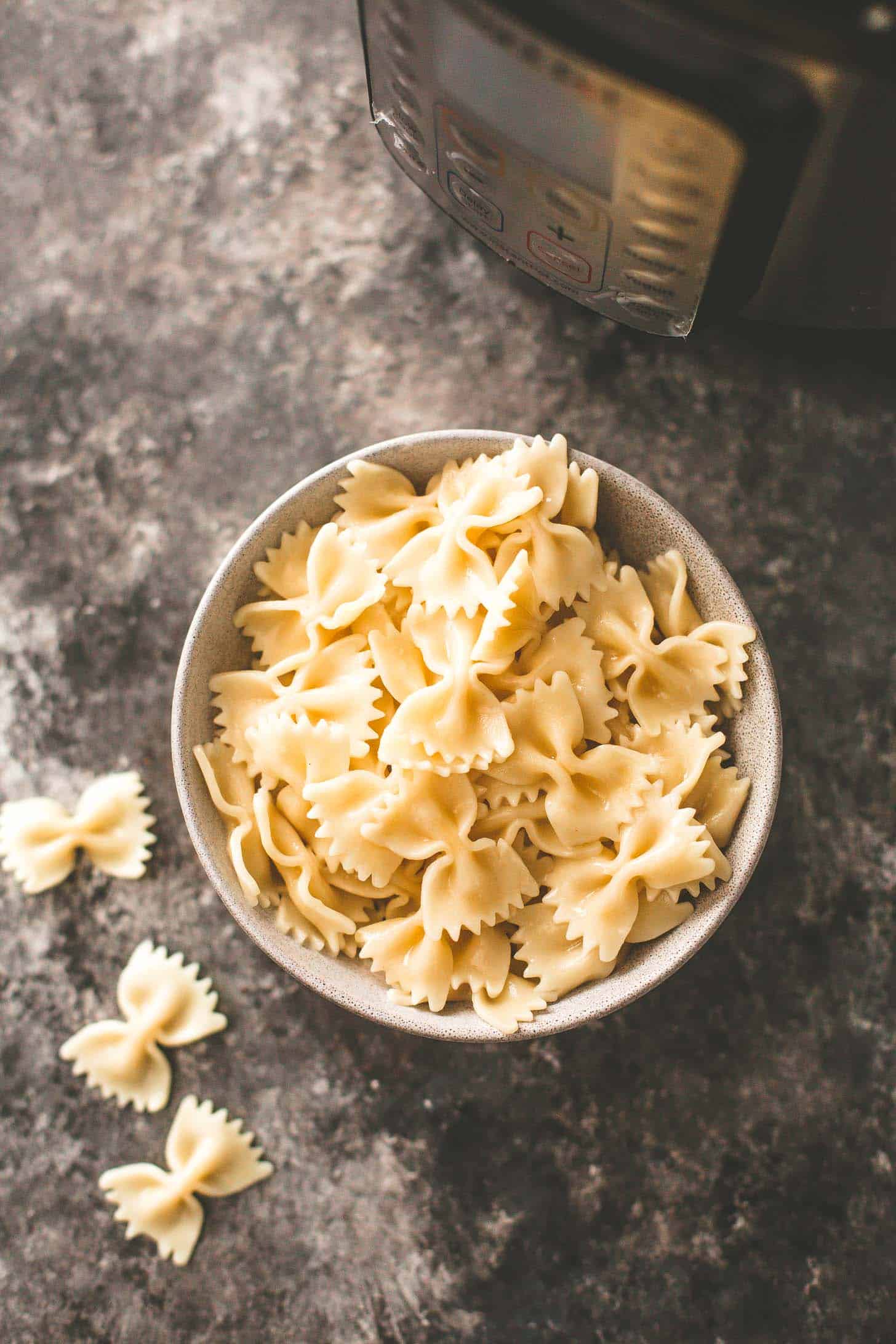
Use these easy step-by-step instructions to cook perfectly al dente pasta in a 6-quart Instant Pot / pressure cooker. I tested this method with 20+ varieties of pasta to insure that it works every time. With over 1 million page views and 300+ positive reviews this method is tested and perfected.
Reader Julie says: ⭐⭐⭐⭐⭐ Three years after finding it, I’m still using this formula!
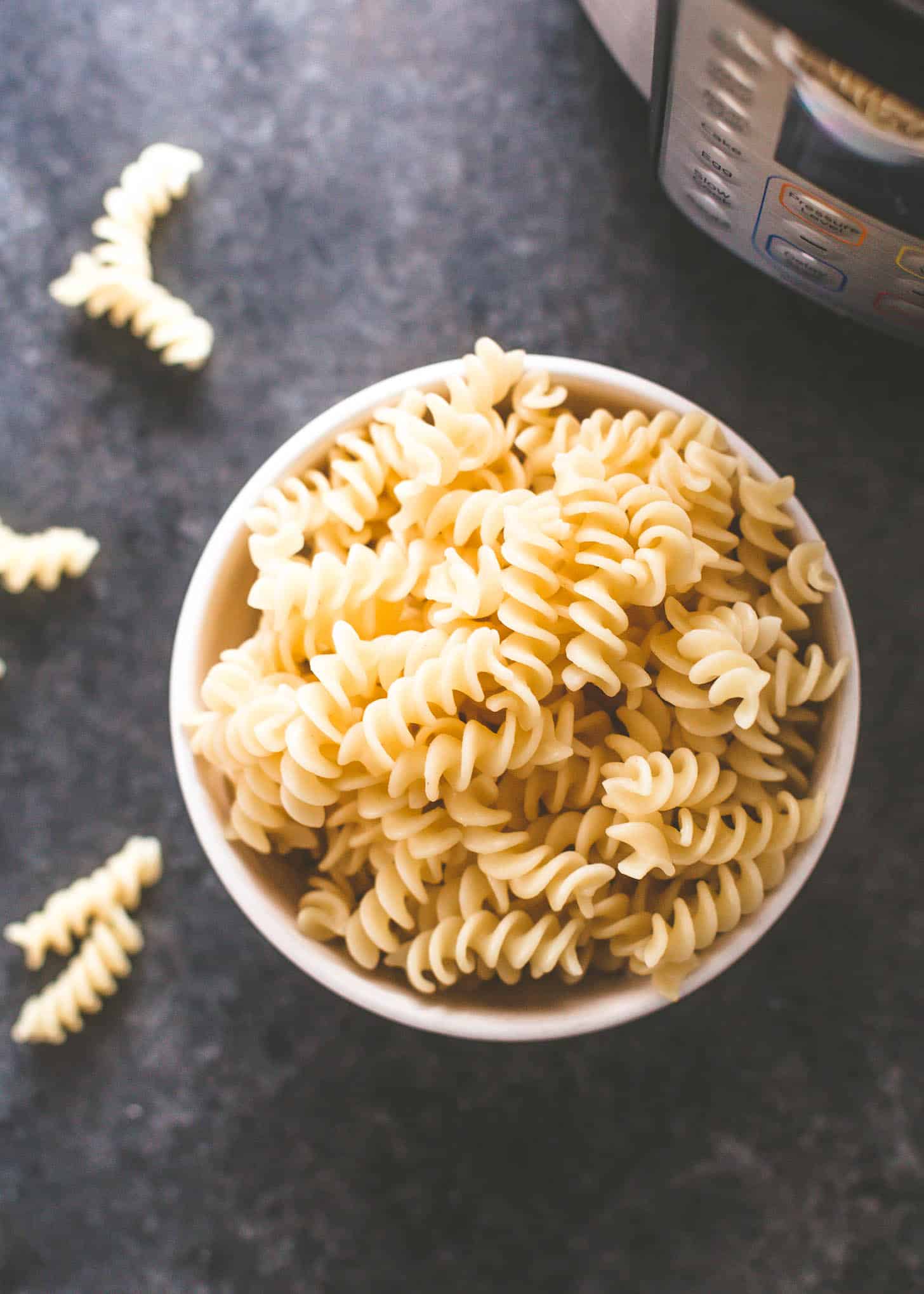
Pasta has been my Instant Pot nemesis ever since I fell in love with the kitchen gadget of the moment. In the past few years I’ve become pretty confident when cooking in the pressure cooker. It only took a few weeks to get over my fear of releasing the pressure valve. 😉
These days, I use the pressure cooker a couple times a week to make everything from rice, to a big pot of Crispy Pork Carnitas, to 20-minute weeknight meals like Chickpea Curry with Rice. But pasta is tricky.
That is, until I learned the Instant Pot pasta formula. It involves a tiny bit of math, but the payoff is perfectly tender pasta every time. Here’s how it’s done.
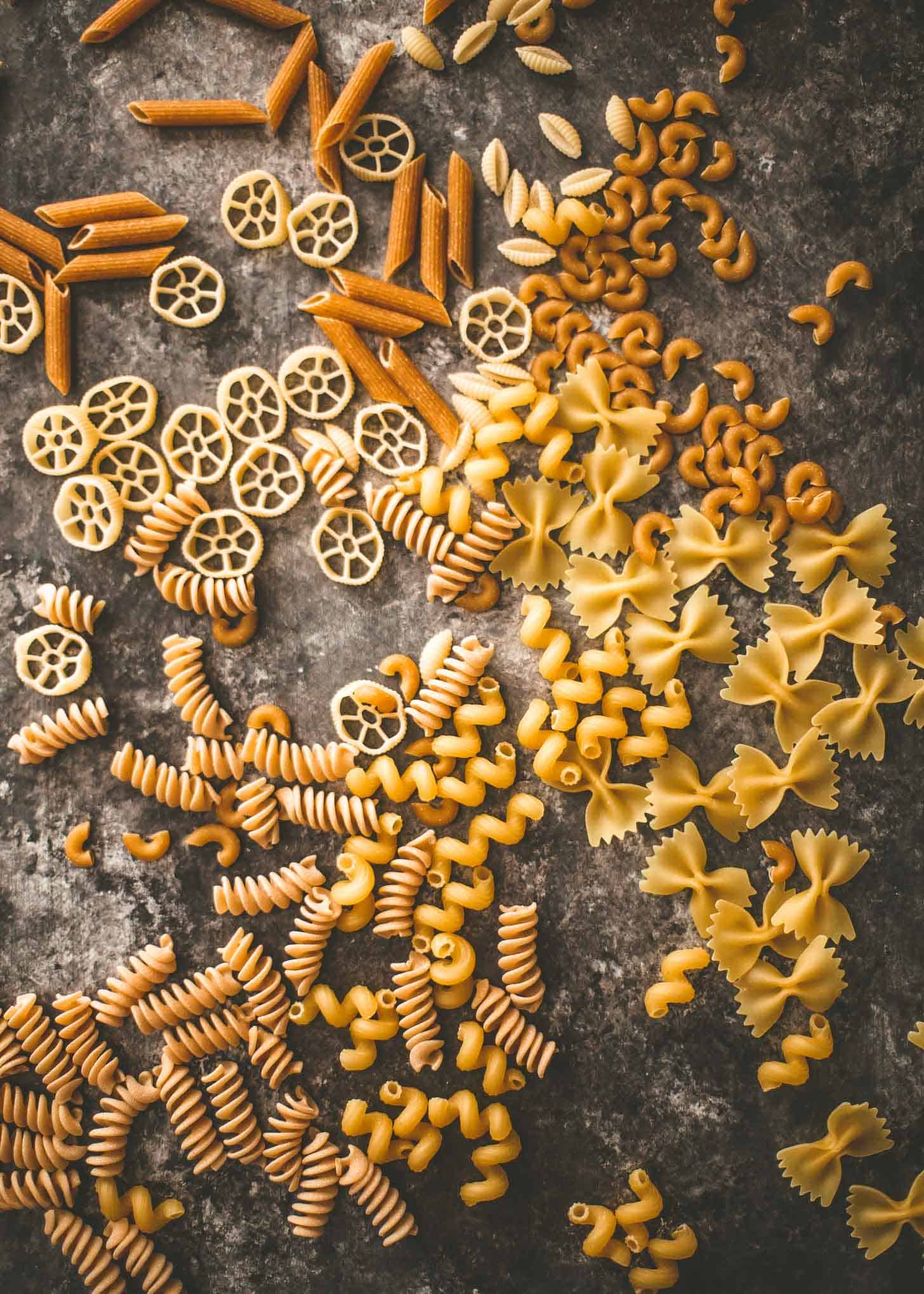
Why Cook Pasta in the Instant Pot
There are three reasons to cook pasta in the Instant Pot / pressure cooker.
- It’s a true one pot dish. No need to strain the pasta after it’s done because the pasta will absorb all of the water as it cooks.
- Set it and forget it. There’s no need to keep an eye on the pot to make sure it doesn’t boil over. Just turn the machine on and walk away.
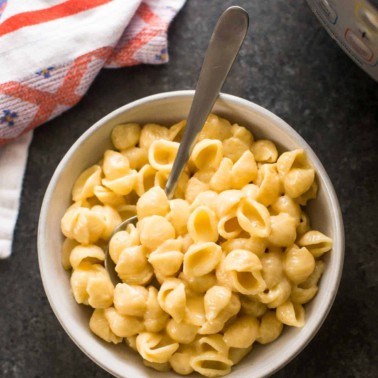
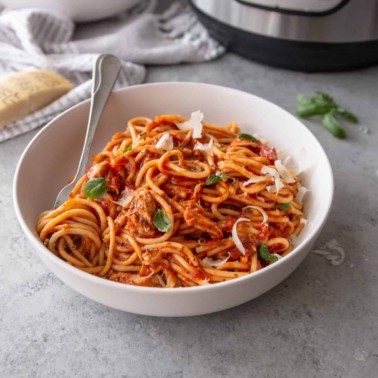
- Keep the starch – Since the pasta isn’t strained, all of the natural starch from the pasta stays in the pot and serves as a natural thickener for any type of sauce you add – whether it’s marinara sauce (as in Instant Pot Chicken Spaghetti) or creamy cheesy sauce (as in Instant Pot Mac and Cheese).
Pin this now to save it for later
Pin It NowThe Instant Pot Pasta Formula
To cook any type of pasta perfectly in the Instant Pot (note: you do NOT need to do this math yourself – just wanted to show you how I did it):
- Find the recommended cook time on any box / bag of pasta.
- Take the lowest, even number in the range. (Example: if the range is 9 to 10 minutes, use 10 minutes. If only one time is given and it’s odd, round down. So 7 minutes becomes 6.)
- Divide in half.
- Subtract two minutes.
- Pressure cook on high.
- Use 5 minute natural release and then release any remaining pressure manually.
But there’s no need to do all that math. Just use the chart below:
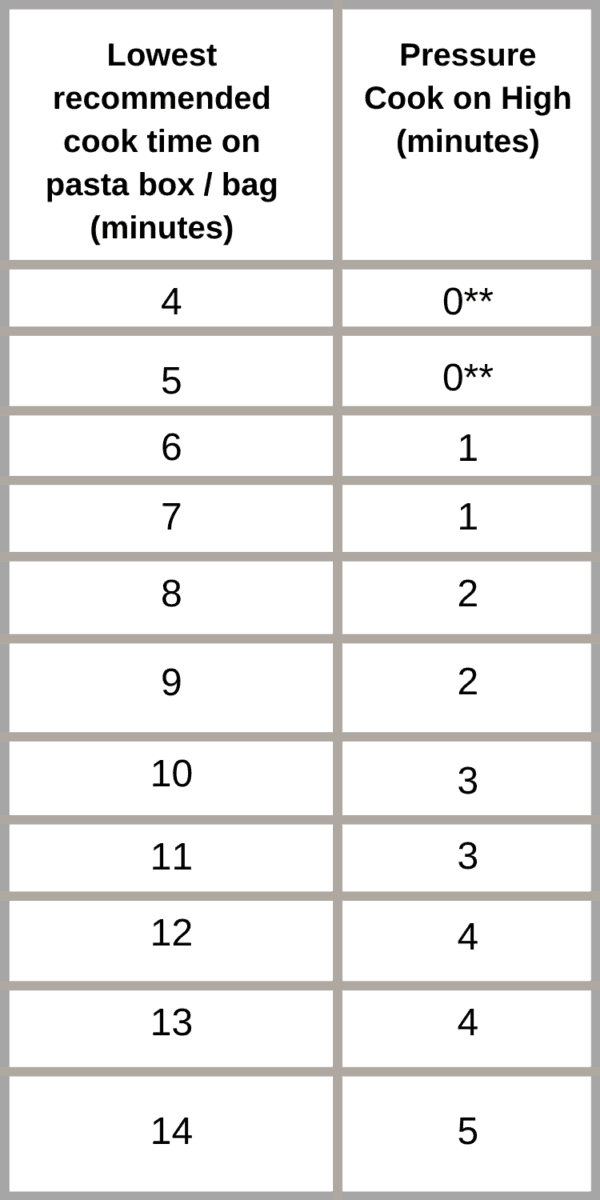
**0 is a real setting on the Instant Pot / pressure cooker. For small pasta shapes with a short recommended cook time, set the timer to zero minutes. The pressure cooker will fully pressurize but won’t hold for any amount of time.
How Much Water to Use for Instant Pot Pasta
Use 2 cups water for every 8 oz of pasta. So…
- 8 oz Pasta + 2 cups Water
- 16 oz Pasta + 4 cups Water
- 24 oz Pasta + 6 cups Water
You can disregard this if you’re cooking pasta in a lot of liquid or sauce (like in a soup or ragu), but the cook times still hold true.
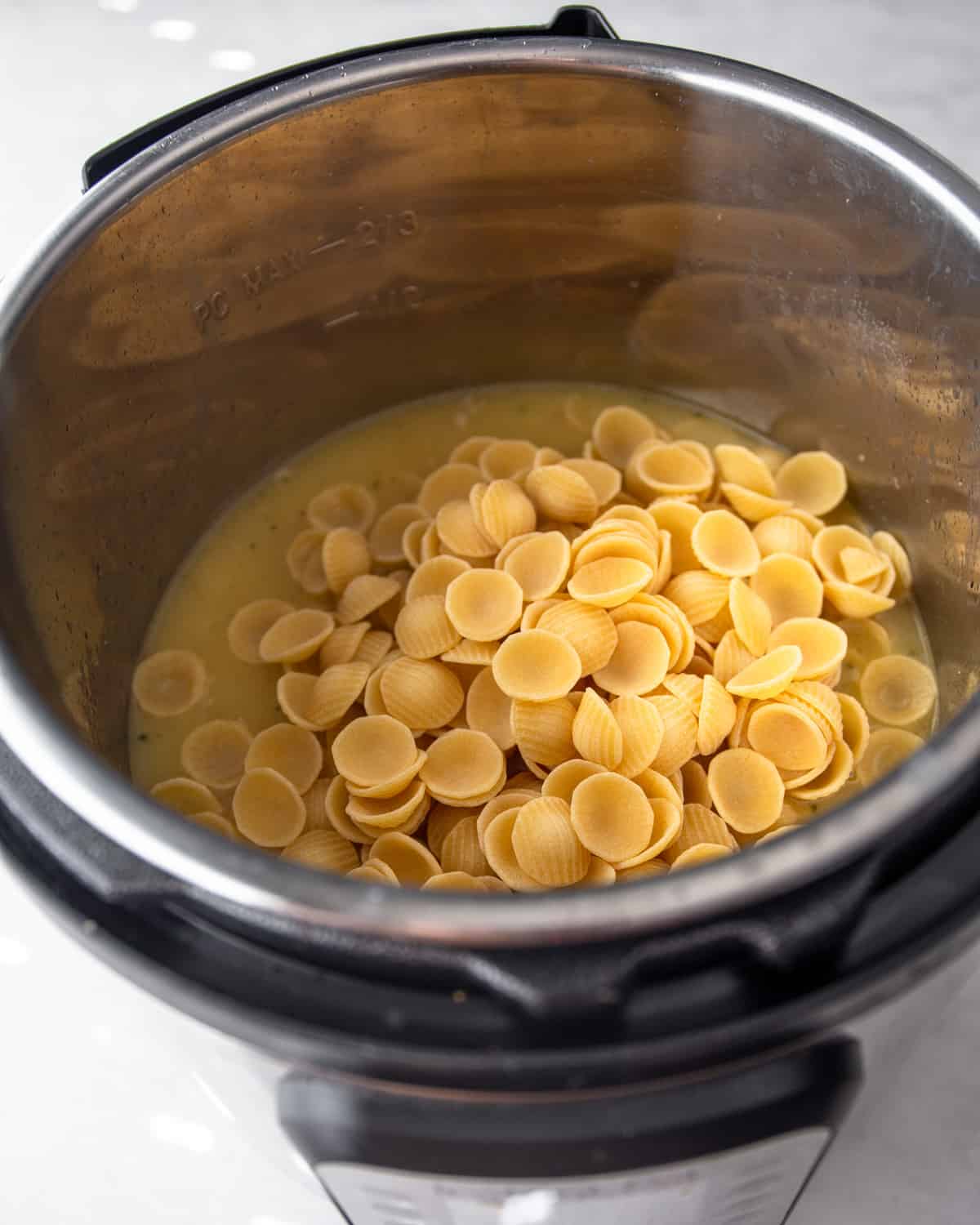
How to Cook Pasta in the Instant Pot
- Combine pasta and water (using measurement above) in the bowl of the Instant Pot. Give everything a stir so that the pasta gets a bit wet.
- Seal and lock the lid.
- Pressure cook on high. (Use the chart above to determine the cook time.)
- Leave the pasta on natural release for 5 minutes (do not let this sit any longer or the pasta may overcook) and then manually release any remaining pressure.
- Unplug the machine or check to be sure that all heating / warming functions are off.
- Open the lid and give the pasta a very good stir – about 20 to 30 times. Put some muscle into it so that the pasta gets really well incorporated with the small amount of water that remains. (Note: When you start stirring the pasta, there may still be a few dry spots on the pasta where it was sticking out of the water. Don’t worry – as you stir and let the pasta steam in the next step, it will continue to absorb the small amount of liquid in the pot.)
- Return the lid (no need to lock it just set it on top) and leave the pasta to sit for 5-10 minutes more. (Note: This step is the most important because the pasta will continue to absorb any remaining liquid and continue to cook just a bit in the residual heat of the machine. This is the key to pasta that is cooked, but not over-cooked.)
- Serve!

Cooking Spaghetti, Fettuccini, or Linguini in the Instant Pot
Long, straight pasta like spaghetti, fettuccini, and linguini can be a bit finicky to cook in the Instant Pot. The method for cooking these is slightly different than other shapes, though the cook time remains the same.
- Break the pasta strands in half before adding them to the Instant Pot so that they can easily be submerged in water.
- Pour water into the Instant Pot to completely cover the pasta (note: this is more water than you add for other pasta shapes).
- Do not stir before cooking. Resist the urge to stir the pasta. (Stirring it can cause it to stick.)
- Pressure cook pasta according to the time on the chart.
- Leave pasta on natural release for 5 minutes and then release any remaining pressure.
- After cooking, stir the pasta well to insure the strands are not stuck together.
- Drain well.
Gluten-Free / Alternative Pasta
There is no need to make any adjustment to the formula if using gluten-free, whole wheat, or alternative pasta. Because this method of cooking pasta is based on the recommended cook time on the package, any type of pasta can be cooked this way.
We tested this method with several varieties of whole wheat pasta and with several varieties of gluten-free pasta (lentil, chickpea, and black bean pasta).
More Instant Pot Pasta Recipes
Pin this now to save it for later
Pin It Now
How to Cook Pasta in the Instant Pot
Equipment
- Instant Pot/Pressure Cooker
Ingredients
- 8 ounces Pasta, any type or shape
- 2 cups Water
- 1/2 teaspoon Salt
Instructions
- First, determine the cook time for the pasta you are using. See the notes below to determine the right time.
- Combine pasta, water, and salt in the bowl of an Instant Pot. Give everything a stir. (See note below if cooking long, straight pasta like spaghetti, fettuccini, or linguini.)
- Close and lock the lid.
- Set the vent to “Sealing”.
- Pressure cook on high for the time determined in Step #1.
- Leave the pasta on natural release for exactly 5 minutes. (Note: Be very careful not to let it sit for any longer or the pasta will overcook.)
- Use manual release to release any remaining pressure. (Note: Hot and starchy pasta water may spray out of the pressure valve when you release it. Cover the valve with a dish towel as it releases to keep this contained and minimize the mess.)
- Open the lid and give the pasta a good stir, 20 to 30 times. (This will get rid of any dry spots that remained where the pasta was sticking out of the water during cooking. If adding sauce, stir it in at this point.)
- Return the lid to the top of the pressure cooker (no need to lock it just set it on top) and leave the pasta for 5-10 minutes more. (Note: This step is the most important because the pasta will continue to absorb any remaining liquid and continue to cook just a bit in the residual heat of the machine. This is the key to pasta that is cooked, but not overcooked.)
- Serve!
Notes
**0 is a real setting on the pressure cooker / instant pot. For small pasta shapes with a short recommended cook time, set the timer to zero minutes. The pressure cooker will fully pressurize but won’t hold for any amount of time.
Spaghetti, Fettuccini, or Linguini – Long straight pasta shapes like these (and angel hair, bucatini, etc.) need to be treated a bit differently than other pasta shapes.
- Break the pasta strands in half before adding them to the Instant Pot so that they can easily be submerged in water.
- Pour enough water into the Instant Pot to completely cover the pasta (note: there is no set amount, but only add water until every strand of pasta is submerged). Add salt.
- Do not stir before cooking. (This will help prevent the pasta from sticking.)
- Pressure cook pasta according to the time on the chart.
- Leave pasta on natural release for 5 minutes and then release any remaining pressure.
- After cooking, stir the pasta well to loosen any strands that are stuck together.
- Drain well.
Nutrition
Nutrition information is automatically calculated, so should only be used as an approximation.












I’ve been trying to find a low electricity usage way to cook noodles that doesn’t take 30 minutes. My induction stovetop is 1800W, and I live at 3500′ feet. Cooking only one serving takes forever. I cook some kind of noodles almost everyday. I tried the small Aroma cooker and that took beyond forever.
Using the mini IP (700W): Garofalo organic spaghetti. One hand full, broken in half. Just barely covered with water. Cooked for 4 minutes. Then immediately unplugged the IP and released the vent. When it was done venting I tasted it and it was Al Dente, but I like mine soft. so I turned on the Saute function and continued to cook until the rest of the water evaporated, Stirring ever so often. Took about 3 more minutes. It was absolutely perfect. Perfecto-mundo!
I did it this way instead of cooking on high for 5 minutes because I feel this might be a basic foundation for cooking all my ramen, noodles, spaghetti. I have more control and the chances of mushiness are low…..the stuff I buy is expensive so I didn’t want to experiment too much and have it turn out inedible.
Doing it this way makes me much happier, thank you so much for giving me the courage to try it. By the time I wash my breakfast dishes, the noodles are done.
So glad this was helpful! Thanks so much for the note and details on the method you used!
Worked very well for my spaghetti last night. Thank you. Love NOT having to drain the water!
Okay yhank you so much for this! My first time using my Farberware cooker and I used your guidelines to make penne, my absolute least favorite to cook because of how long it takes, and it’s perfectly tender. I didn’t measure my water because I wanted to be sure I had enough extra for sauce, but it came out absolutely perfect!
Wonderful! So glad this was helpful Jennifer!
anyone else wondering why not just boil the pasta. Seems that with pressurizing, cooking and then steaming it takes just as much time to cook in the IP as to boil!
You’re totally right, Adrienne – it definitely takes just as much time. The benefits aren’t time savings but in less dishes, no need to watch the pot for boiling over, and the benefit of trapping the natural starches in with the pasta which makes this a great way to start a pasta with sauce!
This has become the go-to noodle starter for any weeknight fast meal. I finally had to leave a review since I have referred back to this post at least weekly ever since I found it.
So easy. We do use chicken broth sometimes instead of water. While it goes I throw some veggies in the cast iron pan to sauté and maybe some crumbled sausage or ham or leftover meat and boom! Dinner in 15 start to finish. Hallelujah for the long day at work starving kids experience.
That sounds like such a good dinner plan, Nancy! I can 100% relate to the end-of-day starving kids experience.
This worked out really well. I needed to use her math to for the smaller quantity I was making. But it worked out great. Thanks for the formula…!
I can’t wait to try this! We just bought an RV and I got an Instant Pot specifically for it …. though I’ve been using it a lot at home too. So my question: my IP is a 3quart. Do I just halve everything in the recipe?
You may need to play around with it a bit, but the recipe should work if you cut it in half for the smaller IP. Congrats on the RV!!
I used organic corn penne 1 lb with 3 cups water, 1 can kroger fire roasted salsa style diced tomatoes, stirred well, cooked for zero minutes, followed your pressure release advice, added melted cheese and thin sliced green peppers, stirred, closed it back up again for 5 minutes. It was the biggest hit with everyone. Glutten free, tasted like tostitos smothered in cheese. Awesome
I’ve looked all through the comments and haven’t found anything on lasagna noodles. Would it work for lasagna noodles too? I will be trying this recipe for other types of pasta. Thank you.
I live alone and would like to know how to cook like 4oz of pasta. Since you call for two cups of water for 8oz am I correct to assume that I could use 1 cup of water for 4oz? Sometimes I just want it as a side dish and don’t want to make a whole bunch. I don’t mind experimenting a little bit but oif I do it right the first time that would be great.
Hi Robert – yes – I would just start by halving both the water and amount of pasta. This would be a good starting point, but as you noted, you may need to play around with it a tiny bit. The steps after the pressure cook are designed to give you a little bit of wiggle room, so hopefully you find that it works great halved the first time around!